Washington Monument
The Lost SymbolThe Washington Monument is both a landmark at the center of the capital and the physical answer to the novel’s final chain of clues. Its 555-foot height, concealed viewing chamber, inscribed aluminum tip, and buried cornerstone connect the Masonic Pyramid’s codes to a revelation about the Lost Word. For Robert Langdon, the monument changes from a familiar national symbol into a structure whose spaces and inscriptions have been present in plain sight, awaiting a change of perspective.
Form and Setting
Standing at the center of the National Mall, the monument occupies a landscape that makes its symbolism visible on a grand scale. From its high viewing chamber, Langdon looks east across more than a mile of darkness to the illuminated dome of the United States Capitol. The Smithsonian museums extend on either side as parallel lines of light, while other windows in the small chamber frame the White House to the north, the Lincoln Memorial to the west, and the Jefferson Memorial to the south. The four directions make the monument seem less like an isolated obelisk than a center point organizing the capital around it.
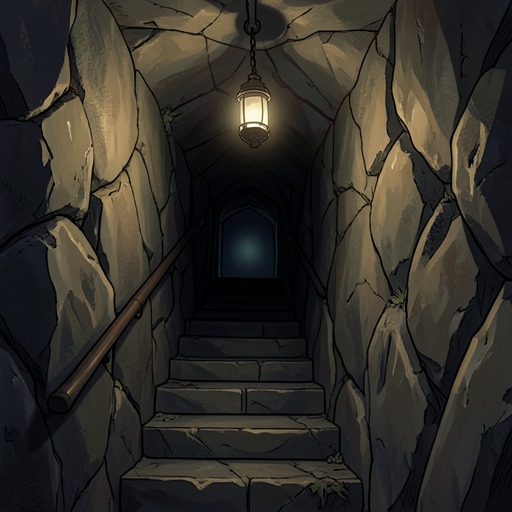
The building’s interior offers a concealed route into that elevated perspective. Its winding staircase consists of 896 stone steps spiraling around an open elevator shaft. Langdon and Peter Solomon descend the stairway after reaching the viewing chamber, passing a stone medallion set into a landing wall. The carving shows a cloaked figure with a scythe and hourglass, pointing toward an open Bible. Its image turns the descent into an interpretive prompt: the answer is not simply a destination outside the monument, but a text whose meaning must be read.
The monument’s scale and construction also carry symbolic weight in the story. Langdon recalls that its capstone weighs 3,300 pounds, repeating the number thirty-three that has recurred in the Masonic clues. At the very top, a polished aluminum tip forms a small pyramid about a foot tall. Aluminum was once as precious as gold, and the tip’s modest size echoes the scale of the stone pyramid that has guided the search. The immense structure culminates in a small, carefully marked point.
The Hidden Chamber and Change of Perspective
The monument’s revelation depends on Langdon reaching a room he does not initially recognize. Peter leads him through a small stone chamber to a glass panel facing darkness. When the flashlight is switched off and Langdon’s eyes adjust, the Capitol’s brilliantly lit dome appears far away across the night. The view overturns his assumptions about the barricaded approach, guarded entrance, heavy exterior door, and automatic doors: those clues have brought him not into an underground vault, but high above the city, to the monument’s pinnacle.
From this unusual vantage, the monument becomes a device for seeing familiar Washington anew. The Capitol appears across the empty space; the White House lies directly north, with Sixteenth Street continuing toward the House of the Temple; and the Mall’s long reflecting pool leads west toward the Lincoln Memorial. Looking south, Langdon sees the Jefferson Memorial beyond the Tidal Basin. The four windows let the setting disclose its geometry in sequence, so that the route through the chamber becomes a survey of the city’s symbolic alignments.
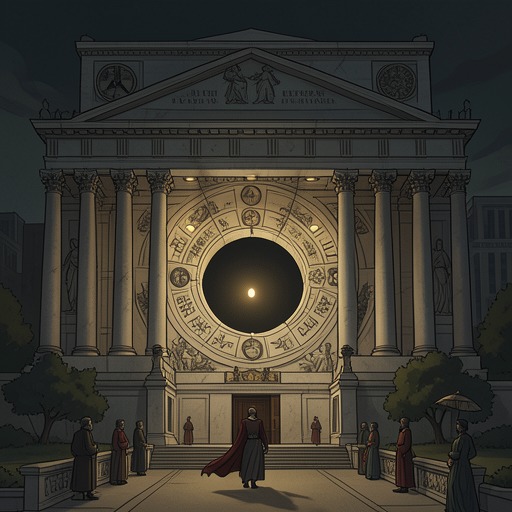
Outside, the plaza supplies another version of the same pattern. Langdon notices two concentric rings of dark stone set into the otherwise white circular pavement. Peter identifies the design as a circumpunct, a circle with a point at its center and a universal symbol for God. The monument thus stands at the center of a circle within a circle, at what Peter calls the crossroads of America. The motif joins the plaza below to the monument above and prepares for the story’s final emphasis on a center that is at once geographic and spiritual.
The Capstone and the Final Cipher
The monument resolves the pyramid’s last code through an inscription displayed at its summit. On the aluminum tip, the Latin phrase Laus Deo is engraved in letters only one inch high. Langdon recognizes that the seven symbols on the base of the stone pyramid are a simple transliteration: they correspond to letters through references including the stonemason’s square, gold, Greek letters, alchemical mercury, and the Ouroboros. Read together, they give the phrase Laus Deo, meaning praise God.
The inscription is visible yet easily overlooked: it is on the monument’s east-facing tip, exposed to view but tiny against the whole structure. At the chamber window, Langdon understands that the pyramid’s final code has pointed to this exact message. Peter confirms the solution, and Langdon recalls that Peter had spoken the words earlier without his recognizing their significance. The monument makes the cipher’s principle concrete: the answer was not hidden by being inaccessible, but by being too small and too familiar to command attention.
The reveal also completes the story’s repeated movement between object and interpretation. The pyramid’s clues have seemed to promise a secret address or a concealed treasure, but their solution directs Langdon toward a public monument and an inscription already displayed there. The monument’s height makes the capstone difficult to see from the ground; the chamber supplies the perspective from which the clue becomes legible. Its architecture does not merely contain the answer. It determines how the answer can be seen.
The Cornerstone and the Lost Word
At the end of the stairway’s revelation, Peter explains that the Lost Word was buried in the monument’s cornerstone on July 4, 1848, during a full Masonic ritual. He identifies the object as a single copy of the Bible concealed inside the hollow cornerstone. The claim draws on the function of cornerstones as buried foundations and small vaults: they mark a building’s first step upward from the earth and can preserve objects intended as messages or tokens for the future.
Langdon initially resists the idea that the Ancient Mysteries could be contained in one book, much less in a single word. He has understood such wisdom as dispersed across many writings, traditions, and centuries. Peter distinguishes the name from the reality: the Lost Word is not literally a word, though the ancients called it the Word. The Bible’s place in the story therefore shifts from a physical object concealed beneath the monument to a body of writing whose meanings remain to be interpreted.
As they descend the 896 steps, Peter points to the carved medallion and argues that sacred texts preserve concealed wisdom beneath their surface narratives. He invokes the Bible’s use of parable, riddles, and dark sayings, and extends the point beyond Christianity to other revered texts. The monument’s cornerstone does not provide Langdon with a single decoded formula. Instead, the buried Bible represents a continuing interpretive task: the Lost Word is preserved, but its significance depends on how readers approach the text.
Sunrise and Narrative Significance
The monument’s final appearance comes at dawn, when Langdon and Katherine Solomon stand on a small skywalk around the pinnacle of the United States Capitol dome. From there, they face west along the National Mall and watch the Washington Monument in the morning light. Katherine explains that the monument’s capstone is illuminated by the first ray of sunlight to reach the capital each day, revealing Laus Deo. As the light spreads across the 3,300-pound capstone and begins descending the obelisk, an architectural detail becomes a daily image of connection between heaven and earth.
The scene joins the monument’s physical height to the novel’s argument about human potential. Langdon thinks of the rising light as enlightenment, and of the monument as a structure through which the mind of humanity reaches upward. Peter had believed the monument was built to stand taller than anything else in the capital; Katherine notes the old law that forbids any building in the city from exceeding its height. The story leaves the precise historical motive for that law uncertain, but makes the visible consequence part of the image: the obelisk remains the city’s defining vertical point.
The sunrise also transforms the novel’s movement from darkness toward disclosure into something cyclical rather than final. Light travels down the monument during the day and, as Langdon imagines it, reverses its course at evening. Against the concealed Bible beneath the foundation and the tiny inscription above, the monument holds together what is buried and what is displayed, what requires interpretation and what can be witnessed directly. Its decisive significance is not that it simply hides a treasure, but that it teaches Langdon to see the capital’s familiar forms as a connected argument about wisdom, faith, and human possibility.